
Been offered induction for big baby?
This is increasingly common. Pregnant women are told that a scan shows that their baby is bigger than average, and induction is recommended. If they decline, they may be offered a planned caesarean instead.
But did you know that there are pros and cons to induction and caesarean, and that – as I will discuss below – around 60% (or six in ten) of the babies who are thought to be big on a scan are actually of normal weight when they are born?
In this blog post, I explain the evidence and the issues on the topic of induction for big baby, and I hope it will help you to make the decisions that are right for you.
Induction for big baby: what’s the evidence?
When I first wrote this blog post, we were awaiting the results of a research study called The Big Baby Trial.
Before the trial was carried out, this is what the researchers who were running the study wrote:
“…it is not clear whether it is better for women with big babies to have their labour induced or to wait for labour to begin naturally.” (Warwick Clinical Trials Unit.)
In other words: when a scan suggested that a baby might be large for its gestational age, they didn’t know whether it’s better to induce labour or to wait.
So they ran a trial to try to find out.
The Big Baby Trial
The trial has now finished. it was actually stopped early, as I explain here. The main analysis showed no difference in the outcomes between the babies whose mums’ labours were induced at between 38 and 38+4 weeks of pregnancy, and the babies whose mums’ experienced ‘standard care’, which meant that their labours weren’t automatically induced in that timeframe.
When the researchers analysed the data a different way and removed some of the women from the analysis, the results showed that there was a marginal difference in one outcome. But with both means of analysis, there were no differences in the rates of neonatal (baby) outcomes. I have a whole blog post which unpacks the trial here.
In other words, even if induction makes a small difference to the incidence of shoulder dystocia (which is a clinical diagnosis, not an outcome in itself), that doesn’t translate into an improvement in other outcomes.

And we know that induction and caesarean have short-, medium-, and long-term consequences and risks for women and babies.
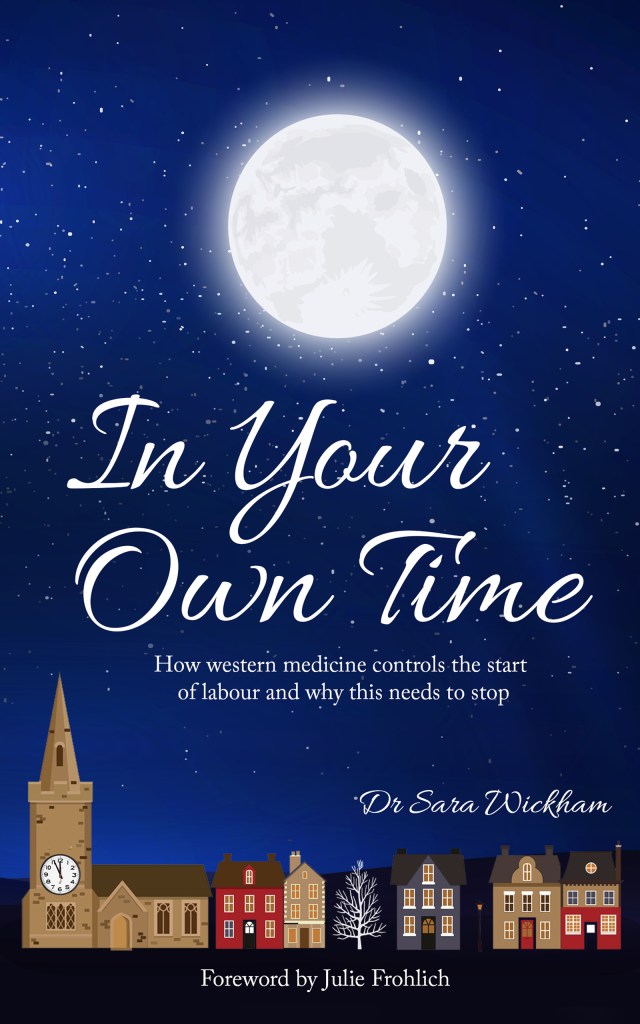
The original version of this blog post is based on my chapter on this topic in In Your Own Time: how western medicine controls the start of labour and why this needs to stop.
It’s called Does my baby look big in this?
In Your Own Time explains the evidence and, I am delighted to tell you, has already helped loads of women and families to understand the evidence and find the confidence to make the decisions that are right for them.
What’s the problem?
But let’s get back to explaining the problem in this area.
In a nutshell, the idea of inducing labour for suspected big babies is based on a series of assumptions.
Unfortunately, those assumptions don’t really stand up to scrutiny.
The problem we’re trying to solve is something called shoulder dystocia.
“[Shoulder dystocia] is when after a baby’s head has been born one of the baby’s shoulders becomes stuck behind the woman’s pubic bone, delaying the birth of the baby’s body.” (Warwick Clinical Trials Unit.)
This happens in about one in 150-200 births, depending on what data you look at. We think it might occur less often when women are able to move about freely, so that’s why the estimates that come from of hospital-based studies and obstetric researchers tend to suggest that it’s a bit more common than when you look at data from home and birth centre settings.
But either way, it’s not an everyday occurrence, though it’s not a rare event either.
Defining shoulder dystocia
Here’s a bit more on what the big baby trial researchers say about shoulder dystocia:
“[Shoulder dystocia] is when after a baby’s head has been born one of the baby’s shoulders becomes stuck behind the woman’s pubic bone, delaying the birth of the baby’s body. Most babies born that have experienced shoulder dystocia will have no long term complications. But for some babies this can cause a stretching in the nerves of the neck, which may cause long-term weakness in the arm. We know that shoulder dystocia occurs more often in bigger babies but there is uncertainty in how often this actually occurs.” (Warwick Clinical Trials Unit.)
The medical term macrosomia is sometimes used here. It just means ‘big baby.’ You might also see ‘suspected macrosomia.’ That’s when someone thinks an unborn baby might be big at birth. As you’ll see in the next few sections, we’re not very good at guessing that, though.
The problem with the induction for big baby logic
I don’t disagree with what the researchers say in the statement above. But I don’t think it tells the whole story, and there are a few things that I would like to add.
(Again, if you’d like more depth on this and to see the evidence, please see In Your Own Time. I don’t have room for the same depth here.)
- The vast majority of big babies (in fact 94% of those who weigh 4kg or more) won’t have shoulder dystocia.
- Shoulder dystocia doesn’t only occur in big babies.
- We can’t accurately predict which babies will be big.
- Only a few of the babies who have shoulder dystocia will have a serious problem anyway (and remember that only one in 150-200 babies have shoulder dystocia in the first place.)
- Induction has risks and downsides which have to be weighed up against any possible benefits.
- There may be other things we can do to prevent shoulder dystocia, like not having women laying on their backs to give birth.
The ultrasound problem
Let’s look at one of the key issues and something which is affecting many women today. That is, the idea that ultrasound weight guesses are a good predictor of whether your baby is likely to be big.
Spoiler alert: they aren’t.
As above, the idea of using ultrasound to estimate the weight of a baby is linked to a couple of other ideas that aren’t supported by evidence.
We know that 94% of large babies won’t have a problem, and we as yet have no evidence that induction is beneficial or that it will reduce the chance of your baby having shoulder dystocia. Despite this, if your baby is deemed by ultrasound to be big, you’re likely to be offered an induction.
There are actually a good number of studies which have shown that ultrasound weight guesses have a wide margin of error. With babies, the studies show a 15% margin of error either way.

“So for a baby estimated to weigh 4kg (the cut-off point usually used to define suspected macrosomia), a 15% margin either side means the range of the estimate is from 3400g (7lbs 5oz) to 4600g (10lbs 4oz). That’s quite a range. And it’s still only an estimate, not a guarantee. A few babies will weigh more or less than a weight that falls within the 15% margin.” (Wickham 2021).
One interesting finding from The Big Baby Trial was that 58-60% of the women who were in a study researching big babies, whose ultrasound scan showed that they had a suspected big baby, did not actually have a big baby.
The ultrasound got it wrong.
If you’d like more evidence of how ultrasound guesses are wrong, have a look at any of my Instagram posts about suspected big babies. The comments are absolutely full of people sharing the difference between the ultrasound estimate of their baby’s weight and their baby’s actual weight at birth.
More evidence

In 2022, a study published in the American Journal of Perinatology by Newman et al (2022) again showed that fetal biometrics (or the measurements taken during an ultrasound) “have limited ability to predict shoulder dystocia and lack clinical usefulness.”
In other words, this study again showed that ultrasound measurements cannot tell us which babies will have shoulder dystocia at birth.
The study looked at data from more than 1700 women who had uncomplicated births.
They looked at sociodemographic factors (things like age and ethnicity) and maternal anthropometrics (things like someone’s weight) and found that there were no differences between those whose babies had shoulder dystocia and those who did not.
The researchers could find no relationship between the measurements taken at ultrasound and a baby’s chance of experiencing shoulder dystocia.
In fact, only one thing was associated with a higher chance of shoulder dystocia, and that was whether or not the woman had an epidural. Those who had epidurals were more likely to experience shoulder dystocia.
This again begs the question of whether we are focusing in the wrong direction.
Should we add MRI scanning into the mix?
In 2023, a group of researchers published a study which showed that MRI (or magnetic resonance imaging) is a bit better than ultrasound at predicting fetal weight. It’s not perfect, and quite a few women would still be told their baby is big when it actually isn’t, but it turns out to be better than ultrasound.
There are, I will add, rather a lot of downsides to using MRI in this way. The testing process can be stressful, for several reasons. These include the loud sound, and the restricted size of the machine, which will feel even smaller to someone who is very pregnant. We don’t have good data on the effect of MRI on babies. And in some countries there are long waiting lists for MRI scans, which begs the question of whether it is ethical to offer scans to healthy pregnant women ahead of people with suspected serious disease. That is an especially important question where the evidence that induction benefits large babies is itself not there.
So another group of researchers decided to look at this in a hypothetical way, by using data to model the possible outcomes of using MRI as a second test in those found to have suspected large babies on ultrasound (Badr et al 2024). This sort of study can be useful when there isn’t justification to set up an actual trial, or when the funding for such a trial isn’t available. But it isn’t a real-world study, as I’ll come back to in a moment.
Does MRI scanning help?
The results were interesting. Badr et al (2024) found that,
“The superior accuracy of MRI-EFW over US-EFW for the diagnosis of macrosomia could result in lower rates of IOL without compromising the relative advantages of the intervention but fails to demonstrate a significant benefit to justify a replication of the original trial using MRI-EFW as a second-line test.”
There is lots to unpack in just that one line!
Using MRI as a second line test might reduce the rate of induction. Well that sounds positive, but the false positive rate is still higher than many women, families and caregivers would like. There is also still a lack of evidence that induction makes a positive difference. And there is evidence that both the testing (ultrasound and MRI) and the intervention (induction) have risks and downsides which may outweigh the benefits for many people.
The line I really want to point out is the last one. The researchers say that there isn’t good enough data to justify doing a trial, because using MRI fails to demonstrate a significant benefit. Yet it’s possible (because it has happened before) that the statement that MRI scanning “could result in lower rates of IOL” (Badr et al 2024) might be used by some as justification to introduce this into practice. It wouldn’t be the first time that this sort of thing has happened.
A bit more about the downsides
I have written a lot about the downsides to induction, because there is a lot of evidence about this. You can find several blog posts on this topic here.
But one study warrants special mention here, because it showed that current practice in this area does harm.
Baddington et al (2023) “… aimed to explore the implications of an ultrasound prediction of a ‘large’ baby on birthing women’s experiences of their pregnancies and births.”
The results of their study provided, “Evidence that the ultrasound prediction of a ‘large’ baby has negative impacts on women’s experiences of their pregnancies and births, including with regard to their birthing options and relationships with their caregivers.” (Baddington et al 2023).
They showed that, “A ‘large’ baby prediction has a negative impact on women’s experiences.”
“Women take up dominant discourses that frame predicted large babies as a medical problem to be managed, with little tangible improvement in outcomes.”
And, “They struggle with fear and guilt as they experience their pregnancies as sites of risk and are constituted as failed mothers who are responsible for their large babies.” (Baddington et al 2023).

“The prediction of a ‘large’ baby in pregnancy has undeniably negative impacts on women.” (Baddington et al 2023).
The importance of thinking before saying ‘yes’ to an ultrasound scan
This raises important issues about ultrasound screening in late pregnancy.
Many women agree to ultrasound screening in late pregnancy without being aware of the very real risks it poses.
If you accept a late pregnancy ultrasound, there is a very real chance that your baby will be deemed to be large, and you will be told that you need induction.
Even if you decline induction, you may find that you are pressured, or that your options are restricted. However, many of the babies deemed to be large on ultrasound are not larger than average.
And researchers have found that women’s experiences may be negatively affected by late pregnancy ultrasound in other ways as well.
So why are we offering induction?
All of this begs the question of why so many women are being offered induction for a suspected big baby. The prevention of shoulder dystocia is the main reason for offering this, as I explained above. And yet ultrasound estimates of a baby’s possible weight and size do not predict which babies will be larger and/or have shoulder dystocia.
I do have an answer to that question of why induction is being offered so frequently, by the way. It’s because what’s happening in the maternity services isn’t based on the evidence. It’s based on tradition, culture and some old ideas that we really need to move on from. More about that in In Your Own Time too.
If you find yourself being offered a late pregnancy ultrasound scan, or an ‘induction for suspected big baby,’ please make sure you’re informed before you decide whether this is something you want.
Look at the evidence for yourself.
But please, be aware that what is currently being offered by mainstream maternity services isn’t always evidence-based. And your caregiver may be interpreting the evidence differently from how you would interpret it.
And make the decisions that are right for you.


If you’d like more in-depth information or to learn more about the evidence, you might enjoy In Your Own Time and/or Inducing Labour: making informed decisions. My book What’s Right For Me? also contains lots of information about birth-related decision making.

About the Author: Dr Sara Wickham is an author, speaker, and researcher specialising in pregnancy, birth and maternity care. Her work focuses on evidence-based, woman-centred information and informed decision-making, drawing on more than 30 years of midwifery knowledge and experience.
Want to stay up to date and get regular updates on birth-related research and thinking sent free to your inbox?
Plus news of Sara’s books, projects, events, and courses?
Sign up to our email newsletter list here
We’ll send you regular, friendly updates to help you keep up-to-date and stay informed.

Books to help you become informed and make the decisions that are right for you…


If this blog post or any of Sara’s work has helped you or those you care for, please buy her a coffee and help us continue to provide independent birth information online as well as in her books.
Thank you.